
When people talk about blockchain, they usually mean networks like Bitcoin or Ethereum, which anyone can use for almost anything. However, more and more projects are choosing a different route: an AppChain, an application specific blockchain built for one purpose or industry. So what’s the difference, and why could an AppChain be the right answer for crowdfunding?
What is a general purpose blockchain?
A general purpose blockchain is a public network that many different applications share. Payments, games, trading platforms and digital collectibles all run on the same chain at the same time.
These networks have real strengths. They’re widely used, well tested and secured by large communities. In addition, nobody needs to build anything new to start using them.
However, sharing a network with everyone comes with real issues:
- Unpredictable fees: every application competes for the same space, so when activity spikes, fees rise for everyone.
- No industry rules: the network serves everyone, so it can’t set rules for one industry.
- Security risks between chains: when different platforms use different blockchains, they need bridges to connect them. Bridges have been behind some of the largest hacks in crypto.
- Complexity: each platform builds its own solution on a different chain, with different tools and standards, so systems don’t work together easily.
- Someone else’s coin and governance: fees are paid in that chain’s own coin, such as ETH on Ethereum, and the network’s future is decided by its own community, not by the industry using it.
What is an AppChain?
An AppChain is a blockchain designed for a single application or industry. Instead of sharing space with everything else, it runs with rules, tools and fees built around one specific use.
An AppChain can be built as its own independent Layer 1, or as a Layer 2 that settles on a larger network such as Ethereum. In short, a general purpose blockchain is a generalist, while an AppChain is a specialist.
Four options, side by side
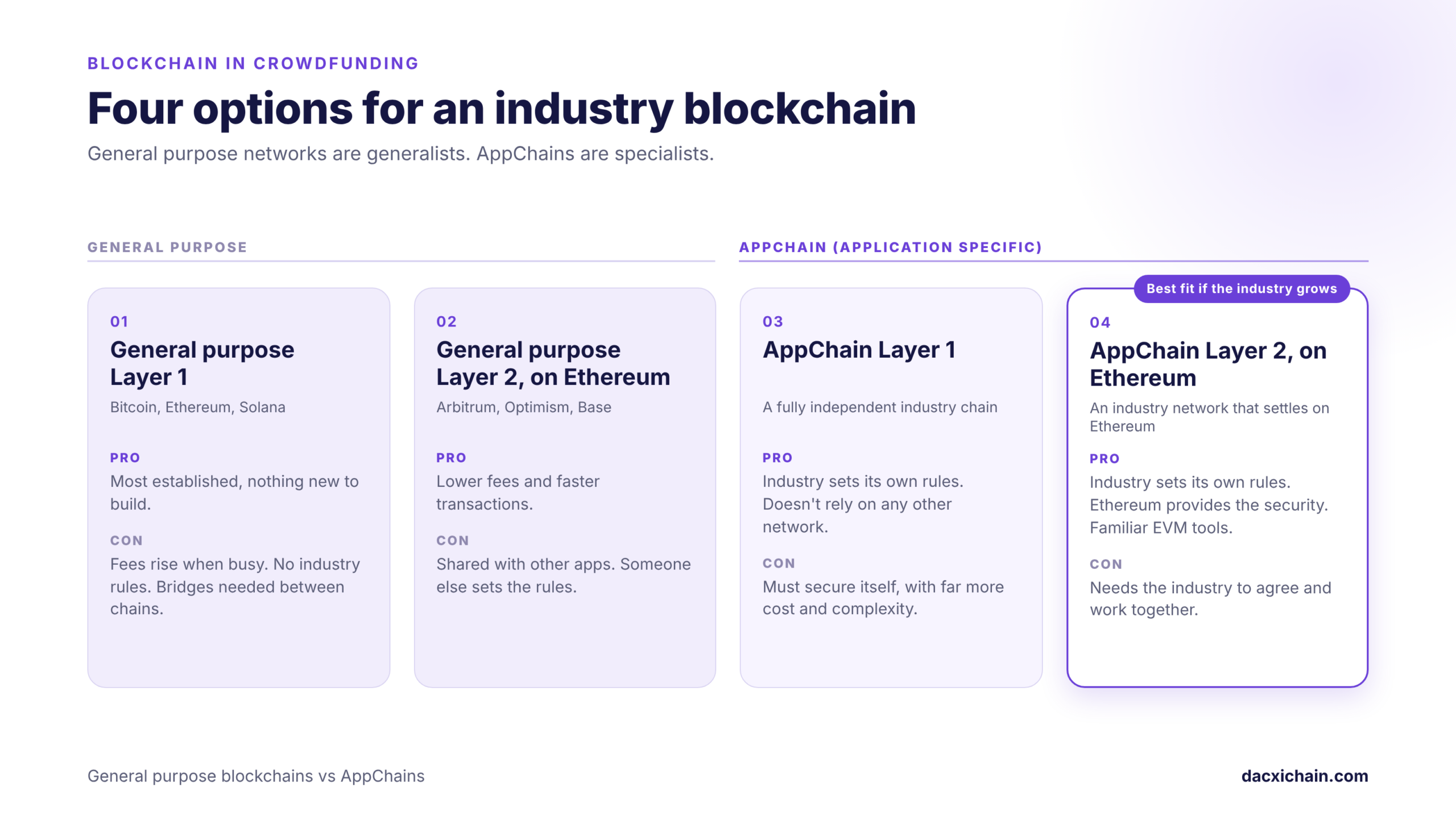
In practice, an industry looking at blockchain has four main options.
-
General purpose Layer 1
This means using a main public blockchain such as Bitcoin, Ethereum or Solana directly. It’s the most established option and needs nothing new to be built. However, fees can rise when the network gets busy, and the industry has no say over the rules.
-
General purpose Layer 2, on Ethereum
Layer 2 networks such as Arbitrum, Optimism and Base run on top of Ethereum. They offer lower fees and faster transactions. Still, they’re shared with many other applications, so someone else sets the rules.
-
AppChain Layer 1
An industry could build its own fully independent blockchain. It would be completely self-contained, but it would also have to secure itself from day one, which means far more cost and complexity.
-
AppChain Layer 2, on Ethereum
Here, an industry builds its own network that settles on Ethereum. It can set its own rules and tools, while Ethereum provides the security. It also uses the Ethereum Virtual Machine (EVM), so developers can work with tools they already know.
Why crowdfunding needs an AppChain
Crowdfunding is regulated, and it operates across many countries with different rules. That makes it exactly the kind of industry an AppChain is built for. An AppChain answers each of the issues that come with a general purpose blockchain:
- Predictable fees: the network doesn’t compete for space with unrelated activity, so platforms can plan their costs.
- Industry rules: platforms can agree on common standards, such as who can hold a tokenised share or what a verified deal record looks like.
- Better security: with one chain for the whole industry, platforms need fewer bridges between blockchains, which reduces one of the biggest security risks.
- Less complexity: every platform works with the same technology, tools and standards, so systems connect easily and deals can move across platforms.
- The industry’s own coin and governance: fees, staking and decisions about the network stay with the industry that uses it.
In other words, an AppChain lets the industry design the network around its own needs, instead of adapting to a network built for everyone.
The future of crowdfunding decides the answer
The right choice depends on where you think crowdfunding is going.
If AI and blockchain don’t transform the industry, it struggles to solve the main issues holding back its potential.
Blockchain has six uses that can help unlock crowdfunding’s potential, and the industry faces a choice today. Does it let each platform choose its own blockchain, building different solutions in isolation and repeating the same mistakes without interoperability? Or does it use one standardised, industry specific blockchain, with simpler technology interfaces, smart contracts and common standards?
If Crowdfunding 2.0 unlocks the industry’s potential, on towards a €1 trillion sector, then an industry solution is by far the best option. Since the benefits come from blockchain features, the simplest, cheapest and most efficient route is a Layer 2 AppChain. And since the EVM ecosystem on Ethereum is the most widely accepted and developed in the world, that Layer 2 should be on Ethereum.
The challenge isn’t the technology. It’s getting the industry to agree on it.
What it means for the coin
There’s one more difference worth knowing. On a general purpose blockchain, fees, staking and governance run on that chain’s own coin. An AppChain works the same way, but specifically for that blockchain. So the fees, staking and governance on that network run on its own coin.
As a result, the credibility and value of the coin are linked to the real demand behind the AppChain ecosystem it serves. We’ll look at how that potential is worked out in a future article.
What comes next
Across the crowdfunding industry, platforms are using AI to solve efficiency issues, and they will use blockchain to secure their data. Very soon, they’ll be in a position to embrace cross-platform, cross-border transactions at scale, which will only happen with blockchain technology.
Dacxi Chain is developing infrastructure for the global crowdfunding industry, starting with trusted data. If you missed them, read our earlier articles on six ways blockchain builds trust in crowdfunding and a new use case for blockchain in crowdfunding.