
When people think about blockchain in crowdfunding, they usually think about tokenisation: turning shares or property into digital tokens. It’s an important use case. However, there’s another one that could matter just as much, and it starts with crowdfunding due diligence, before anyone creates a token.
The problem: proving a deal was checked properly
Before a crowdfunding deal goes live, a platform reviews it. For example, it looks at the business, the offer terms, the documents and the collateral. Today, AI is making crowdfunding due diligence faster and more thorough.
But once the platform finishes its review, how does anyone else know what it checked? In most cases, an investor, an auditor, a regulator or another platform has to take the platform’s word for it. In addition, if the records sit in a private database, there’s no easy way to prove that nobody changed them later.
The solution: sealing the evidence
This is where Ironstone comes in. Ironstone is designed to verify crowdfunding deals before they go to market. First, AI reviews the documents and flags any issues. Then a named person at the platform signs off on the result. After that, the platform can seal everything behind the deal (the data, documents, check results and rules applied) into an evidence pack.
The next step is to make that evidence pack independently verifiable, and that’s the job of the blockchain. This part is planned for a later stage of Ironstone.
How it’s designed to work, in four steps
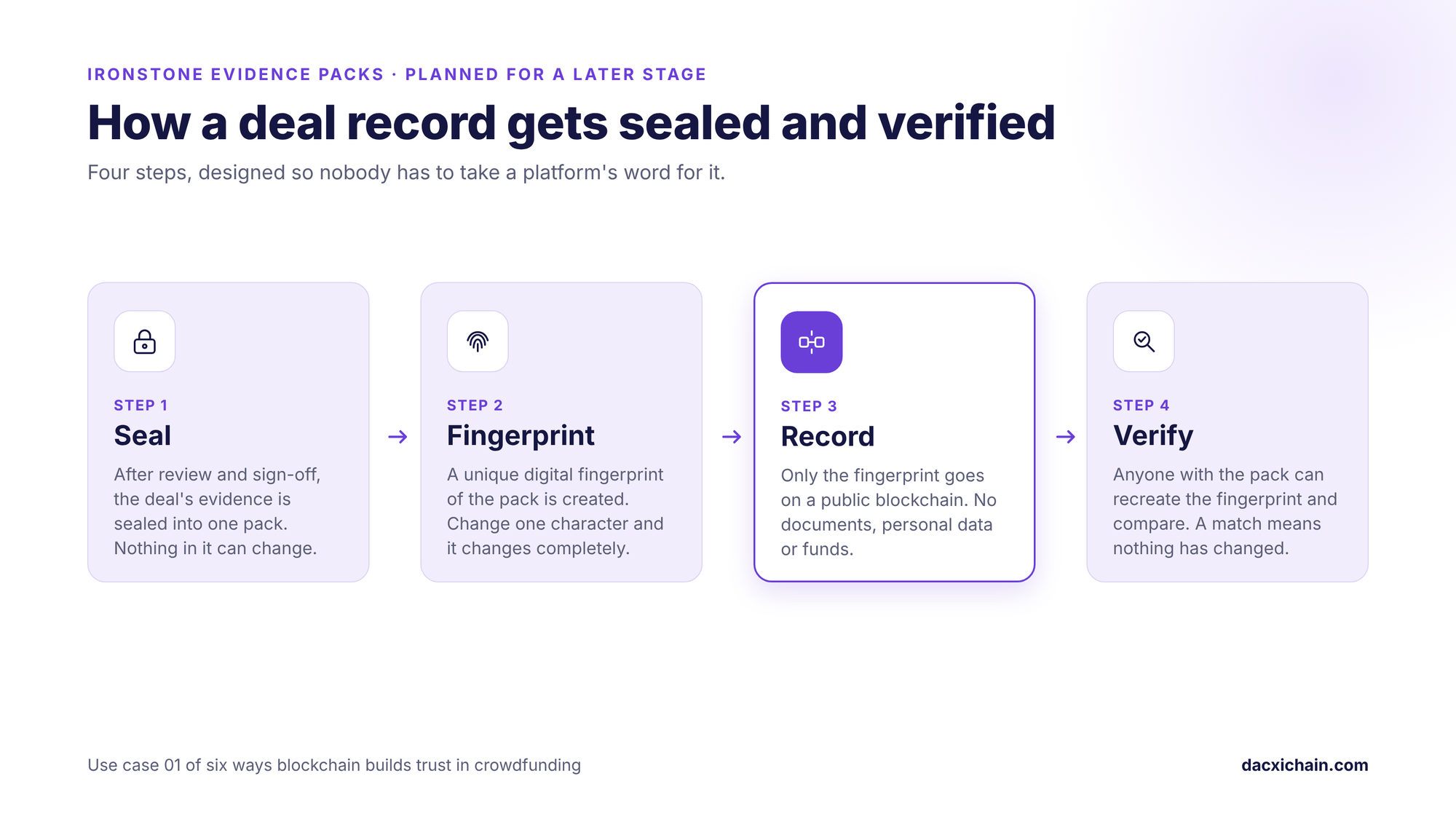
- Seal. The deal manager seals the evidence pack, and from then on nobody can change it.
- Fingerprint. Ironstone creates a unique digital fingerprint of the pack. If even one character changes, the fingerprint changes completely.
- Record. Only the fingerprint goes on a public blockchain. Documents, personal data and funds stay off chain.
- Verify. Anyone with the pack can create its fingerprint again and compare it with the one on the blockchain. If they match, the pack is exactly as it was when the deal manager sealed it.
If something happens after sealing, such as an auditor’s sign-off or a regulatory update, Ironstone adds it as a new record. As a result, the original stays untouched and fully verifiable.
Why it matters
For investors, it means they can check that the deal they’re looking at is the one the platform reviewed. For regulators and auditors, it means records they can verify without relying on the platform. Finally, for platforms, it means they can trust work done by another platform, which opens the door to sharing deals across platforms and borders.
Unlike tokenisation, which mostly happens once per deal, verification happens throughout the life of a deal and across the whole industry. So as more platforms adopt this kind of approach, blockchain activity linked to crowdfunding could grow well beyond what tokenisation alone would create.
Where things stand
Ironstone’s first release focuses on automated deal verification. Blockchain-based evidence packs will follow in a later stage. We’re sharing this now because we believe it’s one of the most important uses of blockchain in crowdfunding, and the industry should start talking about it.
Where Dacxi Chain fits
Dacxi Chain is developing infrastructure for the global crowdfunding industry, starting with trusted data. Evidence packs show clearly why that matters.
Dacxi (DXI) supports this ecosystem and currently operates as an ERC-20 token on Ethereum.
If you missed it, read our previous article: Six ways blockchain builds trust in crowdfunding.