
Crowdfunding has opened up private investing to millions of everyday investors. However, as the industry grows, one question keeps coming up: how do you know you can trust what you’re looking at? That’s where blockchain in crowdfunding is starting to matter.
First, investors need to know that a platform checked a deal properly. Regulators need to trust a platform’s records. In addition, platforms need to trust each other before they can share deals across borders.
At the same time, AI is about to make crowdfunding platforms much faster at checking deals, running compliance and managing investors. That’s what will drive the industry’s growth. But faster isn’t the same as trusted. This is the gap blockchain can fill.
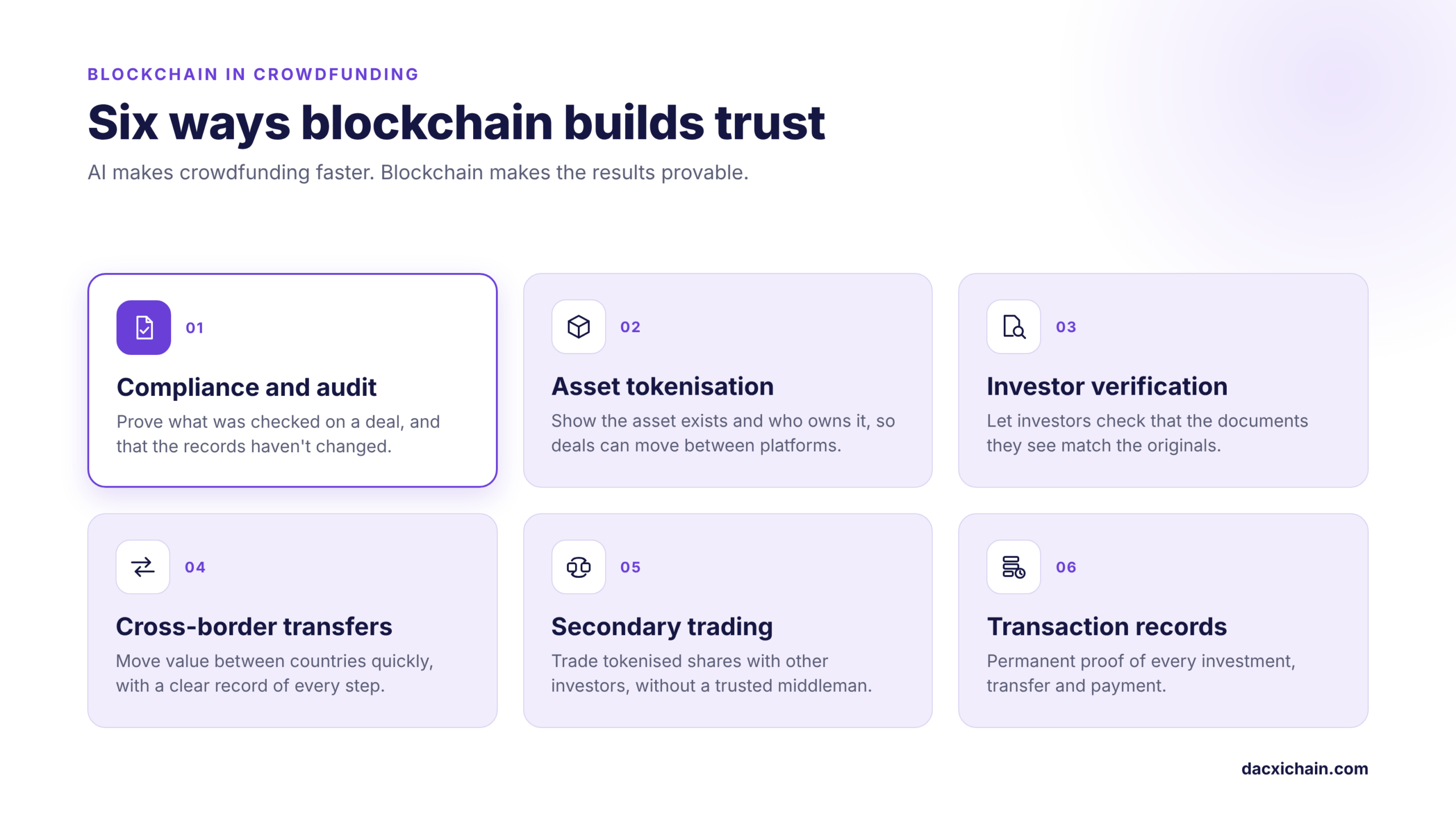
Here are six ways blockchain can build trust in crowdfunding.
-
Compliance and audit
When a platform reviews a deal, it checks the business, the offer terms, the documents and more. Blockchain can prove what the platform checked and show that nobody has changed the records since. As a result, regulators and auditors can confirm it for themselves instead of taking the platform’s word for it.
-
Asset tokenisation
Turning shares or other assets into digital tokens creates a clear record of what exists and who owns it. Any platform or investor can check that record, which builds trust in ownership and makes it possible for deals to move between platforms.
-
Investor verification
Investors can check that the documents they’re shown match the originals. They don’t need any technical knowledge: a simple button can handle the comparison.
-
Cross-border transfers
Moving money between investors and platforms in different countries is slow and expensive today. Blockchain can move value quickly, with a clear record of every step.
-
Secondary trading
Most crowdfunding investments are hard to sell before a company exits. With tokenised shares, investors could hold their investments in their own digital wallet and trade them with other investors, while smart contracts make sure everyone follows the rules.
-
Transaction records
Blockchain can record every investment, transfer and payment as permanent proof of what happened and when. That gives investors, platforms and regulators one shared version of events.
What these have in common
Not every use of blockchain in crowdfunding works the same way. Some of these use cases put a digital fingerprint of a record on the blockchain, so anyone can check it later. Others put the asset or the value itself on the blockchain. Either way, the result is the same: people no longer have to rely on trust alone.
None of this replaces the people who run crowdfunding. It gives them a way to prove their work.
In our next article, we’ll look at one of these use cases in more detail, and why it could become one of the most important uses of blockchain in crowdfunding.
Learn more about what Dacxi Chain is building.