

From Token to Infrastructure: The Long-Term Role of Dacxi (DXI)
The long-term role of DXI is closely linked to the infrastructure Dacxi Chain is developing for the global crowdfunding industry. While recent attention has naturally focused on Dacxi (DXI) as a token, it is only one part of the wider project.
With DXI now available through a decentralised market on Uniswap, much of the recent attention has naturally been on market access, liquidity and on-chain activity.
That matters. A decentralised market gives people another way to access and trade DXI directly from their own wallets. It also makes transactions, liquidity and market activity visible on-chain.
But the token is only one part of the wider Dacxi Chain story.
Dacxi Chain is developing technology for the global crowdfunding industry. The aim is to help crowdfunding platforms work with trusted data, connect with one another and, over time, support activity across different platforms and countries.
In short, DXI is intended to support that ecosystem as it develops. Its role depends on the infrastructure being built around it and the level of real activity that infrastructure eventually supports.
What is Dacxi (DXI) today?
Dacxi (DXI) is currently an ERC-20 token on Ethereum. A total of 10 billion DXI have been issued.
DXI is available through P2B, Wealth99 and a decentralised market on Uniswap. Its availability on Uniswap gives crypto users a way to access the token directly from compatible wallets through an on-chain market.
This is DXI's current position. It is important to separate that from the project's longer-term plans.
Dacxi Chain is not launching a dedicated blockchain now, and no immediate migration has been announced. That possibility belongs to a later stage of the project and depends on the network reaching enough scale to justify dedicated infrastructure.
DXI is part of a wider infrastructure project
Dacxi Chain is not being developed as another general-purpose crypto project. Its focus is infrastructure for the crowdfunding industry.
Today, crowdfunding platforms often operate within separate technology systems, regulatory environments and national markets. Information can be difficult to verify, transfer or reuse, while opportunities available through one platform may have little connection to another.
Dacxi Chain's development plan addresses this through three stages:
- Platform Foundation: creating trusted and portable data through Ironstone.
- Network Infrastructure: connecting crowdfunding platforms and supporting cross-platform and cross-border activity.
- Global Scale: potentially developing a dedicated Dacxi Blockchain if the network becomes large and active enough to require one.
DXI is intended to support this developing ecosystem, but the token should not be treated as the entire Dacxi Chain story.
The first stage is trusted and portable data
Before crowdfunding platforms can work together as part of a wider network, they need information that can be trusted and used across different systems.
This is the role of Ironstone, the verification layer within the Dacxi Chain ecosystem.
Ironstone uses artificial intelligence to review deal information against the obligations that apply to a campaign. It can identify information that is missing, inconsistent or unresolved and connect its findings back to the relevant source material.
The platform's own people remain responsible for reviewing the findings and approving the work. Ironstone does not replace the judgement of a compliance team or remove the platform's regulatory responsibility.
Its record layer preserves what was checked, which evidence was used, who approved it and which version they approved. This is intended to make due diligence faster to complete and easier to evidence afterwards.
For Dacxi Chain, trusted and portable information is the practical starting point. A connected crowdfunding network cannot work effectively if the platforms involved cannot rely on the data moving through it.
The second stage is connecting crowdfunding platforms
The next stage is the network itself.
Crowdfunding remains fragmented. Platforms generally manage their own users, deals, technology and regulatory requirements, often within a particular country or region.
Dacxi Chain's network infrastructure is intended to help participating platforms connect while continuing to manage their own business relationships and responsibilities.
If successful, the network could support the controlled sharing and import of offers between platforms. It could also make cross-platform and cross-border crowdfunding activity more practical.
This is where the longer-term role of DXI starts to become clearer.
The token is not the network itself. It is intended to become part of the economic infrastructure supporting activity within that network as participation and usage develop.
Why would Dacxi Chain need its own blockchain?
General-purpose blockchains such as Ethereum are designed to support many different applications. This makes Ethereum suitable for issuing and operating an ERC-20 token such as DXI today.
An application-specific blockchain, often called an AppChain, is designed around the requirements of a particular network or use case.
For a global crowdfunding network, dedicated blockchain infrastructure could eventually provide more control over transaction costs, governance, validator participation and the rules governing interactions between platforms.
However, building a dedicated blockchain only makes sense if there is enough real network activity to require one.
This is why the proposed Dacxi Blockchain remains a long-term vision rather than a current launch plan. It depends on the crowdfunding network reaching sufficient scale, with participating platforms and meaningful activity across the ecosystem.
Technology should follow a genuine operational need. A dedicated chain would be a response to scale, not a substitute for it.
What could the future utility of DXI include?
If Dacxi Chain eventually reaches sufficient scale and moves to dedicated blockchain infrastructure, DXI is intended to support three main functions.
Transaction fees
DXI would be used to pay transaction fees for activity taking place across the network.
Validator staking
Validators would stake DXI as part of helping to operate and secure the dedicated blockchain.
Governance
DXI would provide a mechanism for participating in decisions about the network and its future development.
These are intended future functions. They depend on the network growing sufficiently and a dedicated Dacxi Blockchain being developed and launched.
They should not be presented as the token's current functionality or as confirmation that a migration is approaching.
Why does scale matter?
A specialised blockchain needs participants, transactions and a clear reason to exist.
Launching one before the network is ready would create infrastructure without enough activity to support it. The more practical approach is to build the underlying services and platform connections first, then assess whether dedicated blockchain infrastructure is justified.
This means the development of Dacxi Chain begins with the needs of crowdfunding platforms rather than with the blockchain itself.
Ironstone establishes a verification and trust layer. The network infrastructure is intended to connect platforms. Only after those foundations have developed would a dedicated chain become a practical consideration.
How should progress be measured?
A token can bring attention to a project, but lasting utility does not come from attention alone.
For Dacxi Chain, the more useful signs of progress will be the adoption and use of its infrastructure. This includes platforms using Ironstone, connections forming between crowdfunding providers, genuine activity across the network and wider participation in the ecosystem.
The same principle applies to DXI's presence in decentralised markets. Liquidity, genuine trading activity and the number of people participating in the market are more useful measures than targeting a particular token price.
Cryptoassets remain volatile and high-risk. Prices can rise or fall, and anyone choosing to participate should understand the market and make their own decisions.
The token supports the network, but it is not the whole story
The long-term role of DXI is connected to whether Dacxi Chain can build infrastructure that crowdfunding platforms find useful.
Today, DXI is an ERC-20 token on Ethereum with access through both centralised and decentralised markets. Its potential future role in transaction fees, validator staking and governance belongs to a later stage of development.
Reaching that stage depends on the growth of the wider network.
Ultimately, the long-term role of DXI will depend on the adoption, scale and genuine activity of the wider Dacxi Chain network.
That distinction matters. DXI supports the Dacxi Chain ecosystem, but Dacxi Chain's work begins with technology for the crowdfunding industry: trusted information, connected platforms and infrastructure that can support activity across markets.
You can learn more about Dacxi (DXI) on the Dacxi Coin page and read the project's longer-term technical direction in the Dacxi Coin (DXI) Whitepaper.
For more information about decentralised access and on-chain markets, read What Actually Changes When a Token Moves Into a DEX Market?
Frequently asked questions
What is the current role of Dacxi (DXI)?
Dacxi (DXI) is currently an ERC-20 token on Ethereum that supports the wider Dacxi Chain ecosystem. Its intended future role may expand if the Dacxi Chain network reaches sufficient scale.
Is Dacxi Chain launching its own blockchain now?
No. A dedicated Dacxi Blockchain is a long-term, scale-dependent vision. No immediate blockchain launch or DXI migration has been announced.
What could DXI be used for in the future?
If Dacxi Chain eventually develops its own dedicated blockchain, the intended utility of DXI includes transaction fees, validator staking and governance.
What is Ironstone?
Ironstone is the verification layer within the Dacxi Chain ecosystem. It uses AI and blockchain-based records to help regulated crowdfunding and private lending platforms complete and evidence their due diligence processes.
Why would Dacxi Chain use an application-specific blockchain?
An application-specific blockchain could give the network more control over transaction costs, validation, governance and platform interactions. It would only be considered practical if the network reaches enough scale and activity to require dedicated infrastructure.
How does DXI fit into the Dacxi Chain ecosystem?
DXI is intended to support the economic activity of the Dacxi Chain ecosystem. Dacxi Chain provides the infrastructure, while DXI could eventually support transactions, network security and governance if the network reaches the stage of operating its own blockchain.


What Actually Changes When a Token Moves Into a DEX Market?
A new exchange listing can sound simple from the outside: a token becomes available somewhere new, and that is that. But when a token moves into a DEX market, more changes than just where you can trade it.
Moving into a decentralised exchange market is a little different.
A DEX changes how people access a token, how trades happen and, importantly, the type of crypto user who is likely to come across it. It does not change the project behind the token overnight, but it does put the token into a different part of the crypto market.
With Dacxi Coin (DXI) becoming available on Uniswap on 17 September, it is worth looking at what that actually means.
From exchange accounts to wallets
On a centralised exchange, users normally create an account with the exchange, deposit funds and trade through the platform. The exchange sits between the user and the market and manages much of the process.
A decentralised exchange works differently.
Users interact with the market through their own compatible crypto wallets. Trades take place on-chain, without the DEX taking custody of funds in the same way a traditional centralised exchange does.
For people who already spend time in DeFi, this is normal. Connecting a wallet and swapping one token for another has become a familiar part of using crypto.
For a token entering this environment, that difference matters because it opens another route for people to find and access it.
The market itself works differently
The mechanics behind trading are also different.
Traditional exchanges generally use order books, where buy and sell orders are matched at different prices. Decentralised exchanges such as Uniswap can instead use liquidity pools and automated market mechanisms to enable swaps between assets.
Rather than waiting for a matching order from another trader, a user can interact with liquidity available in the pool.
This creates a different type of market. Liquidity, trading activity and the balance between assets in a pool all play a role in how that market behaves.
It is one of the reasons a DEX listing should not simply be viewed as another exchange name added to a list. The infrastructure behind the market is different too.
A different way to discover projects
There is also a less technical change that can be just as important: the audience.
Crypto does not have one single community. Some people primarily use large centralised exchanges. Others spend much more of their time using wallets, DEXs and DeFi applications.
These groups overlap, but they do not always discover projects in the same places.
A presence on a DEX puts a token directly into an environment used by people who actively explore on-chain markets. They may find tokens through trading tools, wallet activity, communities or simply by exploring what is happening across decentralised markets.
That does not guarantee attention or trading activity. It simply creates another point of discovery, and one that reaches a particularly crypto-native part of the market.
More access also means more responsibility
There is another side to decentralised access that is easy to overlook.
When users interact directly through their own wallets, they also take on more responsibility for verifying what they are interacting with.
Token names and tickers can be copied. Fake links can look convincing. Accounts can impersonate legitimate projects, particularly around listings and other events that attract attention.
That makes the contract address and official project channels especially important.
Anyone looking for DXI on a decentralised exchange should verify the information against official Dacxi sources — such as dacxichain.com — rather than relying only on a token name, ticker, message or link received from someone else.
Decentralisation gives users greater control, but that control comes with the need to check things carefully.
What changes when a token moves into a DEX market: the DXI example
So what actually changes when a token moves into a DEX market? For DXI, the immediate change on 17 September is straightforward: the token becomes accessible through a decentralised market on Uniswap.
It gives existing users another way to access DXI and introduces the token to an environment used by a different segment of the crypto community.
What it does not do is change the purpose of DXI or suddenly change the wider Dacxi project.
DXI remains part of Dacxi's broader work around building infrastructure for a more connected global crowdfunding ecosystem. The longer-term direction, including the development of a dedicated Dacxi Blockchain as the network reaches sufficient scale, is a much bigger journey than any individual exchange listing. You can read more about that direction in the Dacxi Coin (DXI) Whitepaper.
The Uniswap listing is one development within that journey.
A listing is a starting point, not an outcome
It is tempting to judge a listing by what happens immediately afterwards. But access alone does not create a healthy market.
What happens over time depends on whether people discover the token, whether genuine trading activity develops, whether the number of participants grows and, ultimately, whether the project continues to give people a reason to pay attention.
That is why, when a token moves into a DEX market, it is better viewed as opening another door rather than reaching a finish line.
For Dacxi, that door opens on 17 September, when DXI becomes available on Uniswap.
FAQ
What is happening on 17 September?
Dacxi Coin (DXI) becomes available to trade on Uniswap, a decentralised exchange (DEX).
What is different about a decentralised exchange?
On a DEX, users trade directly from their own crypto wallets rather than through an exchange account, and trades take place on-chain using liquidity pools rather than an order book.
Does the Uniswap listing change what DXI is for?
No. DXI's role within the Dacxi Chain ecosystem is unchanged. The listing is a new way to access the token, not a change to the project or its longer-term direction.
How can I make sure I'm interacting with the real DXI token?
Always verify token details, contract addresses and links against official Dacxi channels, such as dacxichain.com, rather than relying on a name, ticker or link shared by someone else.
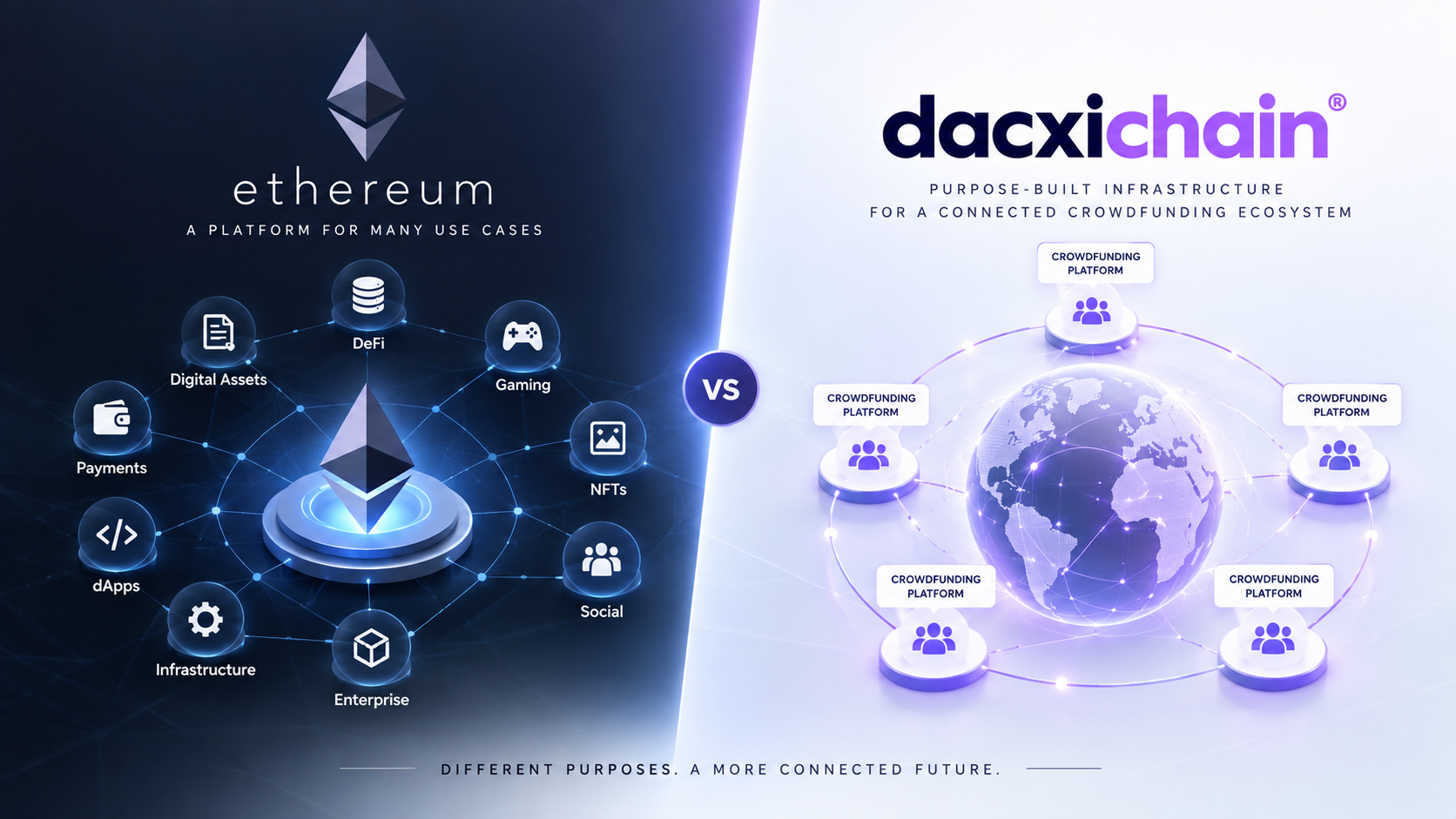
Different Purposes: Dacxi Chain and Ethereum Explained
Blockchain projects are often compared with one another, particularly when they introduce new technology or expand into new markets. One of the most common comparisons is with Ethereum, which has played a significant role in the development of decentralised applications and blockchain innovation over the past decade.
While comparisons are natural, they can also be misleading if they assume every blockchain is trying to achieve the same objective.
In reality, blockchain ecosystems can be designed for very different purposes. Some aim to provide infrastructure that can support thousands of different applications across many industries, while others are designed around the requirements of a specific sector.
Understanding those different objectives provides a more meaningful way to compare projects than simply looking at size or market activity.
Ethereum: A Platform for Many Use Cases
Ethereum is widely recognised as one of the most influential blockchain networks in the industry.
Its primary strength lies in providing an open platform where developers can build decentralised applications, create smart contracts and launch entirely new blockchain-based services.
Over time, this flexibility has supported a broad ecosystem that includes decentralised finance, digital collectibles, gaming, identity solutions and many other applications.
Rather than focusing on a single industry, Ethereum was designed to provide infrastructure that can be adapted to many different use cases.
Blockchains Built for Specific Use Cases
Not every blockchain follows the same model.
Some projects choose to focus on a particular industry or business challenge instead of serving every possible application.
These are often described as application-specific blockchains because their technology is designed around a clearly defined purpose rather than unlimited flexibility.
This approach allows development efforts to concentrate on the needs of a particular market, with infrastructure designed around the users and activity it is intended to support.
It is a different approach to blockchain design, rather than an attempt to replace general-purpose networks.
Dacxi Chain's Focus
Dacxi Chain is being developed with a specific objective: supporting a connected global crowdfunding ecosystem.
Crowdfunding platforms have traditionally operated within individual countries and regulatory environments. While many platforms successfully connect investors and businesses within their own markets, opportunities to collaborate across borders remain relatively limited.
Dacxi Chain's long-term vision is to develop infrastructure that enables greater connectivity between these platforms while respecting the regulatory frameworks in which they operate.
Today, Dacxi (DXI) operates as an ERC-20 token on Ethereum. A dedicated Dacxi Blockchain belongs to a later stage of the project, when the network has developed and reached sufficient scale to justify purpose-built blockchain infrastructure.
Rather than trying to create a general-purpose blockchain for every possible application, the long-term approach is much more specific: infrastructure designed around the requirements of the global crowdfunding ecosystem.
Different Goals Require Different Design Choices
Because blockchain projects pursue different objectives, they naturally make different technical and strategic decisions.
A general-purpose blockchain must support an enormous variety of applications, each with its own requirements and challenges.
A purpose-built blockchain can instead be designed around the functionality needed for a particular market.
Neither approach is inherently better. They simply reflect different design philosophies based on the problems each project is trying to solve.
Comparing them directly without considering their purpose is similar to comparing different types of software simply because they both run on a computer. They may share underlying technology while serving entirely different audiences.
Looking Beyond Comparisons
The blockchain industry has matured significantly over the past decade.
Today, success is increasingly measured by whether a project delivers practical value for its intended users rather than by whether it resembles another well-known blockchain.
Some projects succeed because they provide flexible infrastructure for developers across multiple industries.
Others focus on solving specific challenges within a clearly defined market.
Both approaches have a place in the broader development of blockchain technology.
For Dacxi Chain, this distinction is particularly important. The intention is not to create an alternative to Ethereum or compete for the same role. The two are designed around very different objectives.
Building Technology Around a Specific Market
As blockchain adoption continues to expand, specialised infrastructure is emerging alongside more general-purpose platforms.
Healthcare, supply chain management, digital identity, financial services and other sectors are exploring blockchain technology designed around their own operational requirements.
Dacxi Chain follows the same principle in its long-term blockchain strategy.
The immediate work is not about replacing Ethereum or launching another general-purpose blockchain. It is about developing the platform and network infrastructure needed to support a connected global crowdfunding ecosystem.
If that network eventually reaches sufficient scale, the long-term plan is for a dedicated Dacxi Blockchain designed specifically around that activity.
The objective is not to replicate Ethereum.
Ethereum provides infrastructure for a vast range of applications. The future Dacxi Blockchain is intended to serve a much narrower purpose: supporting the Dacxi Chain global crowdfunding network.
Ultimately, that is a more useful way to understand the difference than comparing the two simply because they both use blockchain technology.
Frequently Asked Questions
Is Dacxi Chain competing with Ethereum?
No. Ethereum and Dacxi Chain are designed around different purposes. Ethereum provides general-purpose blockchain infrastructure that can support a wide range of applications. Dacxi Chain is focused specifically on infrastructure for a connected global crowdfunding ecosystem.
Does Dacxi Chain have its own blockchain today?
No. Today, Dacxi (DXI) operates as an ERC-20 token on Ethereum. A dedicated Dacxi Blockchain is part of the long-term vision and would come at a later stage, once the Dacxi Chain network has developed and reached sufficient scale.
What is an application-specific blockchain?
An application-specific blockchain, often referred to as an AppChain, is designed around the requirements of a particular application, ecosystem or industry rather than supporting thousands of unrelated use cases. The future Dacxi Blockchain is intended to be purpose-built for the global crowdfunding ecosystem.
Why would Dacxi Chain eventually need a dedicated blockchain?
As the Dacxi Chain network develops, more crowdfunding platforms, participants and cross-border activity could create requirements that are specific to the ecosystem. If the network reaches sufficient scale, dedicated blockchain infrastructure could be designed around those requirements.
What role would DXI have in the future Dacxi Blockchain?
Under the long-term model, DXI is designed to support three core functions within the future Dacxi Blockchain: transaction fees, validator staking and governance.
What is Dacxi Chain working on before a dedicated blockchain?
The earlier stages are about establishing the platform foundation and developing the network infrastructure needed to connect crowdfunding platforms. The dedicated Dacxi Blockchain belongs to a later stage of that development.
Why compare Dacxi Chain with Ethereum?
The comparison helps explain the difference between general-purpose and application-specific blockchain infrastructure. Ethereum is designed to support many different types of applications, while the future Dacxi Blockchain is intended to serve a much more specific purpose within the global crowdfunding ecosystem.